
In This Article
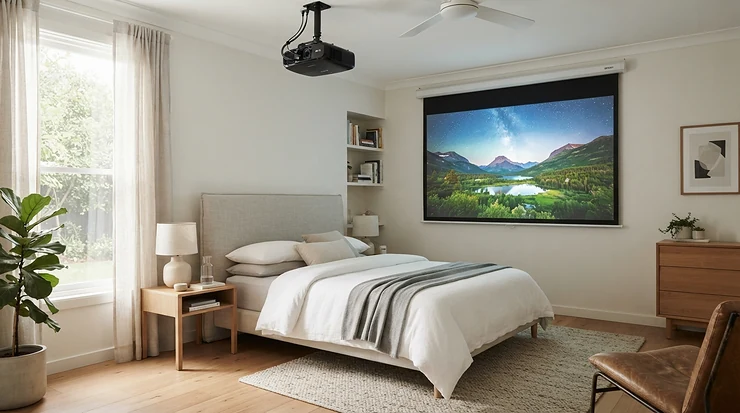
A quiet projector for bedroom ceiling mount is a compact, low-noise projector (ideally rated around 30 dB or lower) that hangs from, or tilts up toward, the ceiling above your bed, so you can watch in a dark room without a fan hum fighting the dialogue.

Here’s the thing about projectors: every one of them is a tiny space heater with a lens. Every lumen it throws makes heat, and every bit of heat has to be hauled out by a fan. In a living room with a soundbar going, nobody notices. In a bedroom at 11 p.m., with a partner drifting off and the house gone quiet, that fan can sound like a hairdryer on a distant planet.
That’s the whole reason this category exists. You want a big, cinematic picture over your bed, and you want to hear nothing but the movie. The good news? Hanging the projector overhead already helps, because distance is the cheapest noise cancelling ever invented. XGIMI’s noise guide leans on the World Health Organization’s night-noise guidance, which centers on roughly 40 dB(A) as a sleep-friendly ceiling. A silent bedroom’s own background can sit at just 20-25 dB, so every decibel counts.
This guide walks through seven real models, from a roughly $300 starter to a fixed-install 4K lamp projector. You’ll also get the decoder ring for the specs that matter, from fan noise decibels to eco mode, plus practical advice on choosing a low fan noise projector for bedrooms and a low decibel projector for bedroom use. One honesty note up front: every figure below comes from manufacturer ratings and published spec sheets, not from a night with a sound meter. Treat the dB numbers as promises worth cross-checking.
Quick Comparison Table: Seven Quiet Bedroom Projectors Ready for the Ceiling
| Projector | Price Range | Resolution | Fan Noise (Normal / Eco) | Best For |
|---|---|---|---|---|
| XGIMI Elfin Flip Plus | $300-$400 | 1080p | ≤28 dB / not listed | Renters and first-timers |
| Epson Lifestudio Pop Plus | $600-$800 | 4K (pixel shift) | 24 dB / 20 dB | Light sleepers |
| BenQ GV50 | $600-$700 | 1080p | 28 dB / 26 dB | Tilt-and-watch simplicity |
| Nebula P1i | $300-$400 | 1080p | 29 dB / not listed | Tight budgets |
| XGIMI Halo+ | $400-$500 | 1080p | 30 dB / not listed | Cord-free test runs |
| Epson Lifestudio Flex Plus | $900-$1,000 | 4K (pixel shift) | 28 dB / 22 dB | Bedrooms with light leaks |
| BenQ TK700 | $1,200-$1,500 | 4K (pixel shift) | 34 dB / 28 dB | Permanent ceiling installs |
Read that table sideways and a pattern jumps out: the quietest rating belongs to the Epson Lifestudio Pop Plus, but the XGIMI Elfin Flip Plus gets within a few decibels for roughly half the money. The BenQ TK700 is the outlier. It is louder at its default setting, yet it is the only true fixed-install projector here, and its 28 dB eco figure narrows the gap. Prices are ranges at the time of research and may vary, so check current price before you commit.
💬 Just one click — help others make better buying decisions too!😊
Top 7 Picks for a Quiet Projector for Bedroom Ceiling Mount: Expert Analysis
These seven are ordered by role rather than strict rank, because the best quiet projector for bedroom ceiling mount duty depends on your ceiling, your wallet and how dark your room gets. Each entry interprets the specs instead of just repeating them.
1. XGIMI Elfin Flip Plus — rotating stand aims straight at the ceiling
The party trick is a fold-out stand that swivels through 150°, so “ceiling mount” can mean “nightstand plus gravity” instead of “drill into plaster.” The spec sheet reads native 1080p, about 500 ISO lumens, a 1.2:1 throw ratio and a fan rated at 28 dB or less. Translated: a six-foot hop from nightstand to ceiling yields roughly a 69-inch diagonal picture, which is enormous when your eyes sit a few feet below it.
Based on the spec comparison, 500 lumens is the sweet spot for a blacked-out room. XGIMI’s own guidance ties 400-700 lumens to the 28-30 dB band, so the low noise isn’t luck, it’s modest brightness. This is the pick for renters, students and anyone who wants ceiling viewing without a toolbox.
On reviews, I couldn’t verify a large pool of independent owner feedback for this newer model. What is verifiable: CompareProjector names it the top bedroom pick, though that site says it relies on manufacturer-rated specs rather than hands-on testing.
Pros:
- ✅ 150° rotating stand needs no mount
- ✅ Rated 28 dB or less
- ✅ Google TV with licensed Netflix
Cons:
- ❌ Modest brightness suits dark rooms only
- ❌ No eco-mode dB figure published
Price check: around $300-$400. For a Google TV projector rated at or under 28 dB, that is the value benchmark of this list.

2. Epson Lifestudio Pop Plus — quietest rating here at 24 dB
Think of this as the “I can hear my own pulse” projector. Epson rates the fan at 24 dB, dropping to 20 dB in eco mode, which sits right at the 20-25 dB ambient floor of a very quiet bedroom. The panel is 3LCD 4K PRO-UHD with pixel shift, around 700 ISO lumens and a 1.2:1 lens, plus Google TV with Netflix.
Here’s what the spec sheet won’t tell you outright: 3LCD means no spinning color wheel, so the rainbow effect some viewers notice on single-chip DLP designs doesn’t apply. Pixel-shift 4K also earns its keep when the picture is large or close to your face, and a ceiling image qualifies on both counts. The trade-off is that it performs best in a dark room.
For sentiment, I couldn’t confirm enough aggregated owner reviews to summarize honestly, so treat the 24 dB claim as a rating until independent measurements surface.
Pros:
- ✅ 24 dB normal, 20 dB eco on paper
- ✅ 4K 3LCD with no rainbow effect
- ✅ 700 ISO lumens for a dark room
Cons:
- ❌ Priciest of the portable group
- ❌ Ceiling-mount interface unverified
Price check: roughly $600-$800 range. Worth it if you share a bed with a light sleeper and the fan is your biggest enemy.
3. BenQ GV50 — 135° tilt and a tiny eco gap
The BenQ GV50 pairs a 135° tilt with Google TV and Netflix, so you can point it skyward and be streaming in minutes. It is a 1080p, 500 ANSI lumen, 1.2:1 projector rated at 28 dB, or 26 dB in eco mode.
That two-decibel gap between modes is interesting. It suggests the engine already idles near its quiet floor, so eco mode costs you little noise headroom but also buys little. Since ISO and ANSI lumens are close but not identical, 500 ANSI lands in the same dark-room territory as the XGIMI Elfin Flip Plus.
Honest take: on rated noise alone, it doesn’t beat the cheaper XGIMI. You are paying for BenQ’s design and that tilt mechanism. Aggregated review data wasn’t verifiable in my research, so I won’t pretend otherwise.
Pros:
- ✅ 135° tilt for ceiling viewing
- ✅ 26 dB in eco mode
- ✅ Google TV with Netflix built in
Cons:
- ❌ Costs more than similar 1080p rivals
- ❌ Dark-room brightness only
Price check: in the $600-$700 range. A good fit if you prefer the brand and want the lower eco figure, but not the value leader.
4. Nebula P1i — budget pick with a 29 dB fan
A name-brand 1080p projector with Google TV and Netflix for around the price of a nice dinner for two. Specs: 380 TÜV-certified ANSI lumens, a 1.25:1 throw and a rated 29 dB fan. It plugs into the wall, so there’s no battery to trigger extra heat.
Interpretation time: 380 lumens is the dimmest projector in this lineup, which is exactly why the fan can loaf. The 1.25:1 ratio needs about 9 feet 1 inch for a 100-inch picture on a wall. For ceiling use, the spacing from nightstand to ceiling will give you a smaller but still generous image. The gap between 29 dB and 28 dB is below the roughly 3 dB change most people can reliably detect.
Reviewers on Amazon had rated it 4.5 stars across 618 ratings at the time of CompareProjector’s check, a decent sample. I couldn’t confirm a rotating stand, so verify tilt range before you plan on ceiling viewing.
Pros:
- ✅ Lowest price among the name-brand picks
- ✅ Google TV with Netflix
- ✅ 4.5 stars across 618 Amazon ratings
Cons:
- ❌ Dimmest projector in this guide
- ❌ Tilt range for ceiling use unconfirmed
Price check: in the $300-$400 range. Excellent value if your bedroom goes properly dark.
5. XGIMI Halo+ — battery lets you test placement before drilling
The XGIMI Halo+ is the “try before you mount” machine. It is a 1080p, 700 ISO lumen projector with a 1.2:1 throw, a 30 dB fan rating and a 59.45 Wh built-in battery.
The battery won’t make it quieter, but it is a clever planning tool. You can prop it at your intended ceiling position, run a movie, and judge noise and picture size before committing to cables and anchors. At 700 lumens, it also copes better with streetlight bleed than the dimmer models, though XGIMI’s rule of thumb says brightness above that level pushes noise past 30 dB.
At 30 dB it sits on the library threshold: present, not intrusive. XGIMI sells ceiling mount accessories, but compatibility with this specific model is something to verify. I found no verified aggregated review data for it.
Pros:
- ✅ 700 ISO lumens beats most dim peers
- ✅ Battery makes placement testing easy
- ✅ 30 dB sits at the “quiet enough” line
Cons:
- ❌ Fan rated at the upper edge of quiet
- ❌ Battery is wasted once it’s permanently mounted
Price check: around the $400-$500 range. Smart if you’re unsure where the projector should live.

6. Epson Lifestudio Flex Plus — 1,000 lumens without a loud fan
This is the one that bends the rules. At about 1,000 ISO lumens, XGIMI’s rule of thumb would predict fan noise above 30 dB. Yet Epson rates the Epson Lifestudio Flex Plus at 28 dB, falling to 22 dB in eco mode. It is a 4K pixel-shift 3LCD projector with Google TV and a 1.2:1 lens.
Take that with a grain of salt: manufacturers don’t measure noise identically, so independent measurements would settle whether it really breaks the brightness-noise trade-off. Even so, the rating makes it the strongest candidate on this list for a bedroom with curtain leaks or a bedside lamp that stays on.
Remember where the 22 dB lives: in eco mode, which dims the picture. Review data was too thin to verify aggregate sentiment.
Pros:
- ✅ Brightest of the quiet portables
- ✅ 28 dB normal, 22 dB eco rating
- ✅ 4K 3LCD, no rainbow effect
Cons:
- ❌ Near-$1,000 price tag
- ❌ 22 dB figure applies only in eco mode
Price check: roughly $900-$1,000 range. A premium for flexibility, and fair if light control is your struggle.
7. BenQ TK700 — the true fixed-install option
Every other model here is a portable. The BenQ TK700 is a traditional 4K gaming projector with a UHP lamp, about 3,200 ANSI lumens (some retailers list 3,000), and listings that confirm ceiling mounting is supported. Fan noise is 34 dB in normal mode and 28 dB in eco mode.
That 34 dB is not whisper-quiet, and one gaming outlet called the fan noticeable in quiet scenes. Here’s the counterweight: open-space acoustics drop roughly 6 dB per doubling of distance, so a ceiling mount several feet above and behind your head earns real relief, though hard bedroom surfaces will cut that benefit. Run it in eco mode at night and you land at a rated 28 dB.
It has no built-in smart platform, so budget for a streaming stick. Best Buy showed 4.3 out of 5 from only 14 reviews, a small sample. Lamp life is quoted in the thousands of hours, longer in eco, and listings vary.
Pros:
- ✅ Ceiling mounting officially supported
- ✅ Plenty of light for a brighter bedroom
- ✅ 28 dB rated in eco mode
Cons:
- ❌ 34 dB in normal mode is audible
- ❌ No smart TV platform; lamp will need replacing
Price check: around $1,200-$1,500 range. The right call only if a permanent installation matters more than whisper-level noise.
Side-by-Side: Noise, Brightness and Mounting Notes
| Projector | Normal / Eco dB | Brightness | Throw Ratio | Ceiling Notes | Best For |
|---|---|---|---|---|---|
| XGIMI Elfin Flip Plus | ≤28 / not listed | 500 ISO | 1.2:1 | 150° rotating stand | Renters |
| Epson Lifestudio Pop Plus | 24 / 20 | 700 ISO | 1.2:1 | Verify mount interface | Light sleepers |
| BenQ GV50 | 28 / 26 | 500 ANSI | 1.2:1 | 135° tilt | Plug-and-point setups |
| Nebula P1i | 29 / not listed | 380 ANSI | 1.25:1 | Verify stand tilt | Tight budgets |
| XGIMI Halo+ | 30 / not listed | 700 ISO | 1.2:1 | Battery for trial placement | Cord-free testing |
| Epson Lifestudio Flex Plus | 28 / 22 | 1,000 ISO | 1.2:1 | Verify mount interface | Light leaks |
| BenQ TK700 | 34 / 28 | 3,200 ANSI | Standard (long) throw | Ceiling mounting supported | Permanent installs |
The table makes the brightness-versus-noise trade-off visible. Everything from the Nebula P1i to the XGIMI Halo+ rises in dB as lumens rise, until the Epson Lifestudio Flex Plus upends the pattern and the BenQ TK700 reasserts it with 3,200 lumens and 34 dB. If you can darken your room, the Epson Lifestudio Pop Plus is the quietest rating, while the XGIMI Elfin Flip Plus is the quiet-per-dollar champion.
✨ Don’t Miss These Exclusive Deals!
🔍 Take your bedroom cinema to the next level with these carefully selected projectors. Click on any highlighted item to check current pricing and availability. These picks will help you create the authentic, whisper-quiet movie nights you’ve been dreaming about!
How to Choose a Quiet Projector for Bedroom Ceiling Mount: 7 Steps
Short answer: pick by noise rating first, brightness second, and mounting method third. Here is the full sequence.
- Set a noise ceiling. XGIMI’s guide calls 30 dB or below “quiet enough” for most bedrooms, and I’d treat that as your cutoff.
- Match lumens to darkness. With blackout curtains, 400-700 lumens is plenty. If light leaks, look at 1,000 or more and accept extra fan noise.
- Check the eco figure. Then ask how much brightness eco mode costs you, because a quiet number you can’t use is just marketing.
- Measure your throw. A 1.2:1 lens gives roughly a 69-inch diagonal from six feet. Use a throw calculator before drilling.
- Confirm how it hangs. A rotating stand is not a ceiling mount. Check load ratings, mount interfaces and weight.
- Look at the cooling design. LED and laser sources run cooler than lamps, and some brands advertise a sealed optical engine to keep dust out.
- Plan the sound. If a partner sleeps, confirm Bluetooth headphone support before buying.

Fan Noise Decibels Explained: How to Read the Spec Sheet
Fan noise decibels sound simple, but three traps hide in the number. First, the scale is logarithmic. A 10 dB increase is perceived as roughly twice as loud, while a 3 dB change is about the smallest difference most listeners can detect, a point echoed in ASHA’s noise guidance. That means 28 dB and 29 dB are, to your ears, a tie.
Second, most manufacturers measure at 1 meter. If your projector sits half a meter from your pillow, XGIMI’s math suggests roughly a 6 dB bump, so a 30 dB rating could land near 36 dB at your head. Mount it farther away and the effect reverses.
Third, check which mode the number describes. Many headline figures come from eco mode. A rated 24 dB that only applies at reduced brightness is a different promise than 24 dB at full output. Compare normal-mode figures first, then treat the eco number as a nighttime bonus.
Finally, remember that noise character matters as much as volume. A steady airflow whoosh at 30 dB is easier to ignore than a thin high-pitched whine at 28 dB. When reading reviews, search for the words “whine” and “coil” rather than just scanning for dB claims.
Low Fan Noise Projector for Bedrooms: What Actually Makes One
A low fan noise projector for bedrooms starts life as a low-heat projector. LED and laser light sources run cooler than traditional lamps, so their fans can spin slower. That is why a compact model like the XGIMI Elfin Flip Plus can hit a rated 28 dB while a lamp-based BenQ TK700 needs 34 dB.
Brightness is the other half of the story. XGIMI’s rule of thumb says bedrooms that are dark can live with 400-700 ISO lumens and stay in the 28-30 dB band, while anything above that tends to push noise higher. In practice, a low fan noise projector for bedrooms is usually one that doesn’t try to be a daylight TV.
Be careful with a tempting shortcut: buying a very bright model and relying on eco mode to tame it. A community reviewer quoted by XGIMI said eco modes on one bright projector were still too loud for quiet movie scenes. A projector built for 500 lumens will usually beat a 2,000-lumen projector in eco mode, because its cooling system was sized for that lower heat all along.
Heat also pools near ceilings, and BenQ notes that higher ambient temperatures make fans work harder. Leave breathing room around the vents.
Low Decibel Projector for Bedroom Use: The Numbers Worth Trusting
What counts as a low decibel projector for bedroom use? One manufacturer’s guide frames it in tiers. Below 25 dB is premium, near-silent territory. Under 30 dB is considered quiet for home theater. Between 30 and 35 dB is acceptable where there’s ambient noise but noticeable in hushed scenes.
Mapping this lineup to those tiers, the Epson Lifestudio Pop Plus (24 dB) and the Epson Lifestudio Flex Plus in eco mode (22 dB) sit in the top tier on paper. The XGIMI Elfin Flip Plus, BenQ GV50 and Nebula P1i occupy the quiet middle. The XGIMI Halo+ touches the threshold, and the BenQ TK700 needs eco mode to qualify.
A low decibel projector for bedroom use is only as honest as its measurement. Look for the test distance, the mode, and whether the number is a maximum or a typical figure. Be skeptical of any listing that shouts a tiny dB value but hides the mode in the footnotes.
Also remember sound is two things: volume and tone. Single-chip DLP designs rely on a spinning color wheel, which one manufacturer guide names as a source of high-pitched whine. If you are sensitive to whine, a 3LCD design avoids that particular culprit.
Eco Mode: The Quiet Button and Its Hidden Price
Eco mode is the first lever to pull. It lowers light output, which lowers heat, which lets the fan slow down. BenQ’s support FAQ lists eco as a recommended step for reducing audible noise, and it also notes that ambient temperature and fan speed play roles, so check BenQ’s guidance on projector noise.
The price is brightness. One manufacturer guide puts the drop at roughly 30-50 percent, which is why a datasheet may flaunt “only 24 dB” while the fine print says eco. In a pitch-black bedroom that trade is painless. With a bedside lamp on, you might find the image washed out.
Practical settings to check:
- Switch the light mode from bright to eco or cinema for night viewing.
- Keep high-altitude mode off unless you live above roughly 1,500 meters (about 5,000 feet), since it makes fans run faster by default.
- Verify the eco figure is the one printed on the spec sheet, such as 20 dB on the Epson Lifestudio Pop Plus or 28 dB on the BenQ TK700.
Eco mode also extends light-source life, a quiet bonus for lamp projectors like the BenQ TK700.
Sealed Optical Engine: Does It Actually Make a Projector Quieter?
A sealed optical engine is a design where the light path is enclosed to keep dust away from lenses and chips. Some product listings pitch it alongside “whisper-quiet” fans, and at least one review roundup attributes a sealed optical engine to a smart projector it recommends for ceiling use.
Here’s the honest analysis. A sealed optical engine doesn’t silence a fan directly. What it does is protect the optics from dust, and dust accumulation is a known reason fans work harder over time. So the benefit is long-term consistency, not a lower day-one dB number.
I couldn’t verify a sealed optical engine claim on any of the seven projectors above, so don’t assume one. If this feature matters to you, look for it in the manufacturer’s documentation rather than a retailer bullet point, and ask whether the cooling intake is filtered.
Treat a sealed optical engine as a tiebreaker, not a headline. Between two projectors with similar ratings, the one with a documented sealed optical engine will probably stay quieter after a year of ceiling-level dust than one without. Still, a sealed optical engine can’t replace basic maintenance, especially on vents mounted close to a ceiling.
Ceiling Mount vs. Shelf vs. Ceiling Projection: Which Is Quietest?
“Bedroom ceiling mount” can mean three setups, and each changes how loud your quiet projector for bedroom ceiling mount really sounds.
| Setup | Noise at Your Ears | Install Effort | Best For |
|---|---|---|---|
| Fixed ceiling mount | Lowest, thanks to distance | High (anchors, cables) | Permanent installs like the BenQ TK700 |
| Nightstand aimed up | Highest, closest to head | None | Renters using the XGIMI Elfin Flip Plus |
| Shelf at foot of bed | Middle | Low | Compromise setups with the Nebula P1i |
The pattern is simple: distance wins. XGIMI’s guidance suggests moving the projector away from the bed or using ceiling projection to push noise farther from your ears, and I’d add that pointing the exhaust vent away from you helps too. A fixed overhead mount gives you the distance bonus but traps warm air near the ceiling, so leave ventilation clearance. If you rent, a nightstand with a rotating stand is the lowest-commitment way to test whether you like ceiling viewing at all.
How to Install and Tune Your Quiet Projector for Bedroom Ceiling Mount
Here is a practical sequence that avoids the classic regrets.
- Test first. Prop the projector at the planned spot for a night or two. A battery model like the XGIMI Halo+ makes this painless.
- Check your math. Use a throw calculator to confirm the image size from your planned distance.
- Anchor properly. Find a joist or a rated anchor, and confirm the mount’s load rating exceeds the projector’s weight. The BenQ TK700 weighs about 6.8 pounds.
- Aim the exhaust away from the bed. It changes perceived noise even when the measured dB doesn’t.
- Set the light mode. Choose eco or cinema for nights, and leave high-altitude mode off.
- Route cables cleanly. Trunking or in-wall routing keeps the look tidy.
- Clean the vents monthly. Dust makes fans work harder, so a quick vacuum pass pays off.
Common first-30-day mistakes: mounting too close to the headboard, forgetting ventilation clearance, and discovering the projector’s remote doesn’t reach a ceiling position. Do a trial run before you commit.
Real-World Scenarios: Three Bedrooms, Three Picks
The college renter. Imagine a 10-by-10 dorm room, a $350 budget and a no-drilling rule. The XGIMI Elfin Flip Plus with its rotating stand, or the Nebula P1i if budget is tighter, fits the brief. Dark room, nightly use, ceiling viewing from the pillow.
The couple with a light sleeper. Picture a 12-by-14 master bedroom where one person watches late. The Epson Lifestudio Pop Plus in eco mode (20 dB rated) pairs with Bluetooth headphones, since most Google TV models can pair them. Budget around $700, environment dark, frequency a few nights a week.
The bright-room gamer. Consider a room with leaky blinds and a console. A fixed mount makes sense, so the BenQ TK700 brings 3,200 lumens and ceiling-mount support, while the Epson Lifestudio Flex Plus offers a quieter, more portable option at about the same cost. Expect to run eco at night.
None of these is universal. Choose by darkness, distance and whether your priority is the quietest low fan noise projector for bedrooms or the brightest picture.
Problem → Solution: Fixing Five Noise Headaches
Problem: the fan roars in quiet scenes. Switch to eco mode, then check whether the exhaust faces you. Rotating it away can cut perceived noise.
Problem: a thin whine you can’t unhear. Tonal noise bothers people more than volume. Read reviews for “whine” before buying, and consider a 3LCD model.
Problem: the fan ramps up after an hour. Heat is likely pooling near the ceiling. BenQ notes higher ambient temperature raises fan noise, so add clearance and clean the vents.
Problem: vibration through the mount. Tighten hardware and check for loose brackets, since furniture and fixtures can resonate.
Problem: you turn the volume up to mask the fan. That trades one problem for another. NIOSH’s noise resources explain how loudness and exposure time interact. Fix the noise at the source, or use headphones to keep volume low.
FAQ
❓ Can I ceiling mount any projector in my bedroom?
❓ Is a LED or laser projector better for a low fan noise projector for bedrooms?
❓ How many lumens do I need for ceiling viewing in a dark room?
❓ Is a low decibel projector for bedroom use worth the extra cost?
❓ Do I need Bluetooth headphone support?
Conclusion
A great quiet projector for bedroom ceiling mount comes down to three decisions. Pick a noise rating you can trust, usually 30 dB or below. Match brightness to how dark you can make the room. Then choose the mounting style that fits your life, whether that’s a rotating stand on a nightstand or a fixed overhead bracket.
If I had to hand you a shortlist, the XGIMI Elfin Flip Plus is the value-and-versatility play, the Epson Lifestudio Pop Plus is the quietest on paper, and the BenQ TK700 is the permanent-install workhorse for brighter rooms. The Nebula P1i covers tight budgets, the BenQ GV50 adds a tidy tilt design, the XGIMI Halo+ helps you test placement, and the Epson Lifestudio Flex Plus brings 4K with a rated 22 dB eco figure.
Remember the fundamentals: use eco mode at night, keep vents clear, treat sealed optical engine claims as a tiebreaker you should verify, and choose a low decibel projector for bedroom use by comparing normal-mode numbers, not just the flattering ones. Distance, dark rooms and a little maintenance do the rest.
Recommended for You
- [Add your blog post link 1]
- [Add your blog post link 2]
- [Add your blog post link 3]
Disclaimer: This article contains affiliate links. As an Amazon Associate, I earn from qualifying purchases. If you purchase products through these links, we may earn a small commission at no additional cost to you.
✨ Found this helpful? Share it with your friends! 💬🤗
